

How To Repair A Suv Front Bucket Seat
Howard is a DIY guy who usually sells a car in better condition than he bought it. He prefers older and foreign cars.
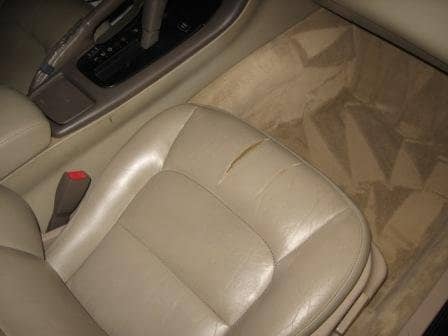
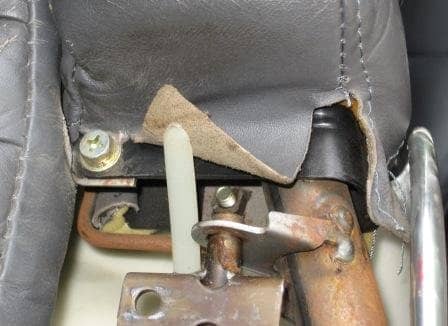
These two rips will just get worse if they are non repaired. The rest of the upholstery is in good shape, although the leather is hardened from sunday exposure.
Howard S.
The boilerplate hobbyist tin can practise a passable DIY seat repair. Forget ugly duct tape or drawstring seat covers! I vary my repair techniques depending on the nature of the impairment.
Rips and tears in auto seats can be divided into two types: Those that border on a seam and those that don't.
For starters, allow'south acknowledge that if you practise it yourself, a repaired seat tear volition never be completely unnoticeable. If you desire it to look like new, you'll have to take it to a professional upholstery shop.
A professional can restore seemingly hopeless leather. In a worst-example scenario, he can completely recover it in material or vinyl, starting at approximately $200 per bucket seat and $250 per demote seat.
Leather materials, nevertheless, will cost considerably more.
Note that this commodity does not directly accost accidental damage due to misuse, such as knife cuts or cigarette burns; nonetheless, similar methods do apply.
Nor does it comprehend repair of porous cloth or velour textile seating—only leather, vinyl or cloth-backed vinyl.
Past the time near cars attain the age that the seat coverings begin to split due to normal vesture and tear, information technology's usually not worth paying to take the seats professionally recovered.
At that signal, about owners will either just ignore the harm or try some easy fix, which is usually ineffective.
Moreover, in one case a rip begins, it will continue to tear if not stopped, and any underlying cream padding that is exposed to sunlight will rapidly deteriorate.
Rips That Are Not on a Seam
When the seat material splits where it is non right up confronting a seam, we have admission to the back on both sides of the rip. For this kind of harm, I glue a piece of fabric to the dorsum of the rip and concord the gap closed while the mucilage dries. That's easier said than done.
If y'all're not sure whether your rip is of this type, gently probe with a screwdriver or similar apartment blunt musical instrument to ensure that in that location is at least ¼ to ½ inch of clearance across the border of the rip.
The platonic tool is a shirt stay, 1 of those little plastic stiffeners that often comes on the collars of men's apparel shirts. In that location volition be layers of padding and perhaps other cloth under the ripped surface material.
Y'all want to exist certain those can exist separated from the top layer—the one you want to patch.
Curlicue to Continue
Read More than from AxleAddict
Selecting Patch Material
It is important to use a suitable patch material. I discover that a scrap of suede or heavy-duty duck cloth used for uniforms works well.
The critical factor for woven cloth is that it not stretch on the warp and woof (all weaves will stretch some on the diagonal). If the color happens to be a close match, information technology may make things easier.
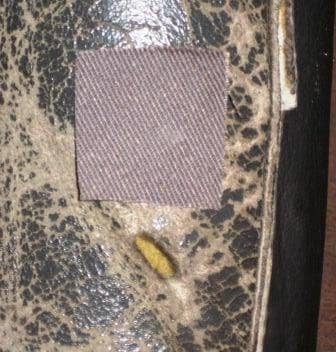
At that place is a pocket-size pigsty beneath the patch. The fabric is cutting almost 1/ii" larger on all sides.
Howard S.
The gray bolster from this Supra bucket seat shows what information technology looks like with the fabric tucked in, before gluing.
I try to orient the cloth so that the warp or woof is aligned with the management of stress. The shirt stay is pointing to the patch, which is nigh invisible now because of the close color match.
Leather Adhesive and Gluing Technique
Adjacent, we demand to utilize weights or clamps to apply directly pressure to the surface in order to press the leather and glued backing together. This is not easy, so I work it out before applying the glue.
The surface is always curved, and then you lot need to press hard enough to flatten the curve or use a curved pressure plate. Have care that your pressure clamps are non widening the gap.
If possible, apply clamps to narrow the gap simultaneously. I did non practice that for the Lexus considering the tan leather had spread apart from drying out and shrinking in the sun. The gray Supra spot is small enough that I didn't bother.

This 2 lb. dolly provided just the correct amount of pressure and shape. The masking tape simply keeps it from falling off. Don't use duct record, which could peel off the top coat!
Howard S.
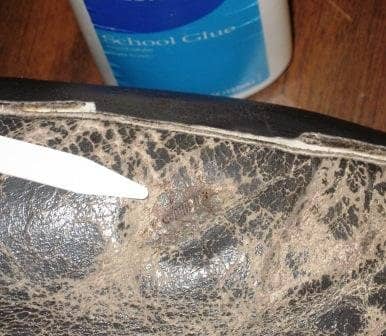
Finished repair is good enough to prevent further damage to seats that are well worn.
Howard S.
There are many suitable adhesives, just the one I adopt is plainly quondam school glue. It is piece of cake to apply, dries clear, remains flexible when dry, and is h2o-soluble for clean-upwardly, fifty-fifty after it's dried.
Professional person upholsterers use special water-based adhesives that set up quickly.
When the adhesive is completely dried, release the pressure level and admire your progress. The greyness Supra repair is finished at this stage.
For the damaged Lexus seat shown hither (tan), the rips were and then long that I chose to patch each end of the rips separately.
I cutting two strips of cloth and overlapped them in the center as I glued them in, tucking glue under each edge with the shirt stay. (The patch should actually exist nigh twice as broad every bit in this example.)
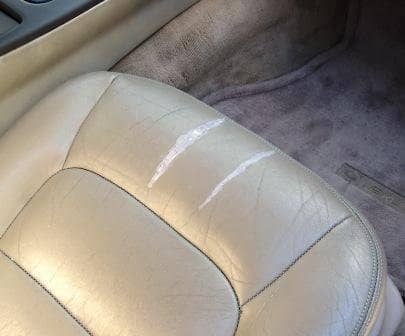
Lack of patience produces a poor color match.
Howard South.
Leather Filler and Coloring
The Lexus leather is quite thick, and so the repair needs a filler to bring it upwardly flush with the seat surface. Various fillers will work. The main requirements are that information technology be flexible, non-shrinking and can be colored in some way.
In this particular instance, I used ordinary inexpensive caulking compound. It was easy to shape, and any excess cleaned upward with water. (I had planned to use a professional product, but discovered at the final minute that mine had dried out.)
It volition usually be necessary to color the repaired area to get it to match the seat colour. Various companies sell kits which enable you to mix colors for vinyl and leather repairs. Getting a shut lucifer is difficult though, every bit you can come across by the tan Lexus example hither.
The colored medium is often of the estrus-cure type. The technique is much similar ironing. The challenge, of course, is to estrus the patch plenty to cure information technology without overheating the surrounding seat material.
There are companies that sell pre-mixed bottles containing an verbal lucifer to your car's seat color. See the last paragraph of this commodity for ordering data.
Rips That Border a Seam
In situations where the rip borders right up against a seam, it normally isn't possible to slip a fabric patch under the seam. In this example, the solution is to patch over the meridian using a remnant of the same leather or vinyl used on the seats.
All seats have some backlog cloth that is hidden from view beyond where it attaches to the seat frame. To admission this requires removing a seat or some office of it.


Color-Matched Leather and Vinyl Patches
Many "all leather" seats will actually have leather on surfaces that will receive the most vesture, but cloth-backed vinyl for the sides or other areas that will receive trivial abrasion. If you lot accept a choice, the cloth-backed vinyl is preferable because it is thinner.
When I removed the gray bolster from the Supra, I constitute a overnice big slice of vinyl, although I never institute where this had actually been used on visible surfaces. Notation the dissimilarity between the thickness of the vinyl (0.0235 inch) and the leather (0.0570 inch).
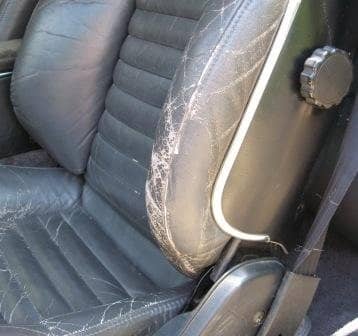
This seat is in a classic car that is still all original, although it shows obvious signs of wear and patina. The owner wants to keep information technology original rather than restoring it.
Howard Southward.
I did not recall of photographing this area before starting. Suffice it to say that the damaged area was well-nigh as long as the patch. It was not nearly that wide, though heavily worn.
Since I was patching anyhow, I made it every bit wide as the scrap textile permitted, thus reinforcing the weakened area that tends to take the nearly habiliment on this type of seat.
Gluing and Clamping Technique
If exposed open-cell foam may come in contact with glue from the patch, I insert a thin non-porous sheet—plastic, wax paper, etc.—betwixt the foam and surface material.
If mucilage is permitted to saturate the cream and harden, it will ruin the sponginess and stiffen it.
Ensure that your pressure plate—the surface that will direct contact the patch and whatever mucilage that squeezes out around it—is less porous than the seat surface.
Otherwise, when you release the force per unit area, $.25 of the seat textile may separate and adhere to the clench. When I use a wood cake, I wrap it with plastic cling wrap from the kitchen in order to release from the glue.
Metal clamps don't need this precaution. Since I utilise a water-soluble mucilage, I can make clean up any residuum with a moist rag.
Positioning a patch that has to border snugly upwards confronting a seam can be hard because it will tend to slide around once glue is applied and because the pressure plate more often than not obscures vision. I practice aligning information technology a few times before applying the glue.
Commercial Products
Kits are available with everything necessary to practise the job. Typical contents include subfabric, adhesive and primary colors for mixing. Kits with a heat-transfer tool work better on vinyl and include a few leather-grain transfer papers.
Those that practise not require heat work better on leather. The toughest function of most basic kits is trying to mix the colors for a good match. Unfortunately, you go what you lot pay for.
The discount auto stores sell just the cheapest kits, ranging from virtually $10 to $25.
Better quality materials are available locally from wholesalers that supply professional shops.
Online specialty retailers such as Leather Magic, MagicMender and LeatherWorldTech that sell to professional shops also have kits for well-nigh $60 that come with a canteen of pigmented leather superlative glaze paint that you specify.
They stock hundreds of pre-mixed colors to match almost whatever production automobile seat. That may well be worth the toll in gild to avoid the bedevilment of trying to mix and match the seat leather from basic colors.
Torn Seat Experiences
This article is accurate and truthful to the all-time of the author's knowledge. Content is for advisory or entertainment purposes only and does not substitute for personal counsel or professional communication in business, financial, legal, or technical matters.

How To Repair A Suv Front Bucket Seat,
Source: https://axleaddict.com/auto-repair/Leather-Repair-Car-Seats-Vinyl-DIY-Auto-Upholstery
Posted by: richardsondrance.blogspot.com
0 Response to "How To Repair A Suv Front Bucket Seat"
Post a Comment